Business systems
The systems a business quietly runs on
Before I became a web developer, I spent more than six years working in operations and as a virtual assistant. I noticed I was spending a lot of time moving the same information between emails, spreadsheets, CRMs, and different tools. None of it was difficult — it was just repetitive. That’s what made me interested in automation.
Today, I build systems that take care of that repetitive work, so people can spend more time making decisions, helping customers, and running their business.
How I think about it
None of this came from a course. It came from being the person doing the repetitive work — and slowly learning what’s worth handing to a machine, and what isn’t.
Start with the work you do over and over.
The small stuff — copying details from an email into a spreadsheet, retyping the same reply — never feels big in the moment. But it's where the hours actually go. That's the first place I look.
Take the busywork, not the decisions.
I'm not trying to replace anyone. The system catches the enquiry, files it, and sends the “got it” — so the person is free for the part that needs a human. With Bahay Liwanag, everything runs automatically right up to the actual “yes, those dates are free.” That call stays with a person, on purpose.
Ask once, then don't ask again.
If someone's already told you their dates, nothing in the system should make them repeat it. One form, and the details land where they're needed — no re-asking, no re-typing.
Keep it somewhere you can actually find it.
Automations only help if what they leave behind is easy to look at later. One clear record per person, in a place built for scanning — not scattered across an inbox, a chat, and three sticky notes.
Build it so the owner can run it without me.
Whoever's left with the system has to be able to open it, understand it, and change a line of copy without calling me. Something clever that only I understand isn't a gift — it's a problem I handed them.
Be honest about what it does.
Bahay's booking page tells guests exactly what happens: send the form, we'll confirm by email, no payment yet. No fake “instantly booked!” when a person still needs to check. People trust a system that's straight with them about its own steps.
Fit the business, not the tool.
I don't start from “what can GoHighLevel do.” I start with how the business actually works — who does what, where things get stuck — and pick the tools to fit that. The tool bends around the way they already work, not the other way around.
The tools, and the job each one does
People ask which tools I use, but the tools matter less than the job each one is doing. Here’s how I think about the ones I reach for most — as roles in how a business runs.
GoHighLevel
The front desk and the customer list
The website, the forms, and every contact live in one place — the first thing a visitor touches, and the record that remembers them afterwards.
Pipelines & workflows
The steps a job moves through
Turning a new enquiry into a booking is a handful of steps. A pipeline makes those steps visible; a workflow quietly does the ones that don't need a person.
Make
The runner between tools
When two tools need to talk, Make carries the information across — so the same details never get typed a second time.
Airtable
The tidy list you work from
A clean, filterable list of everything that came in — built for scanning, sorting, and marking things done.
Systems I've built
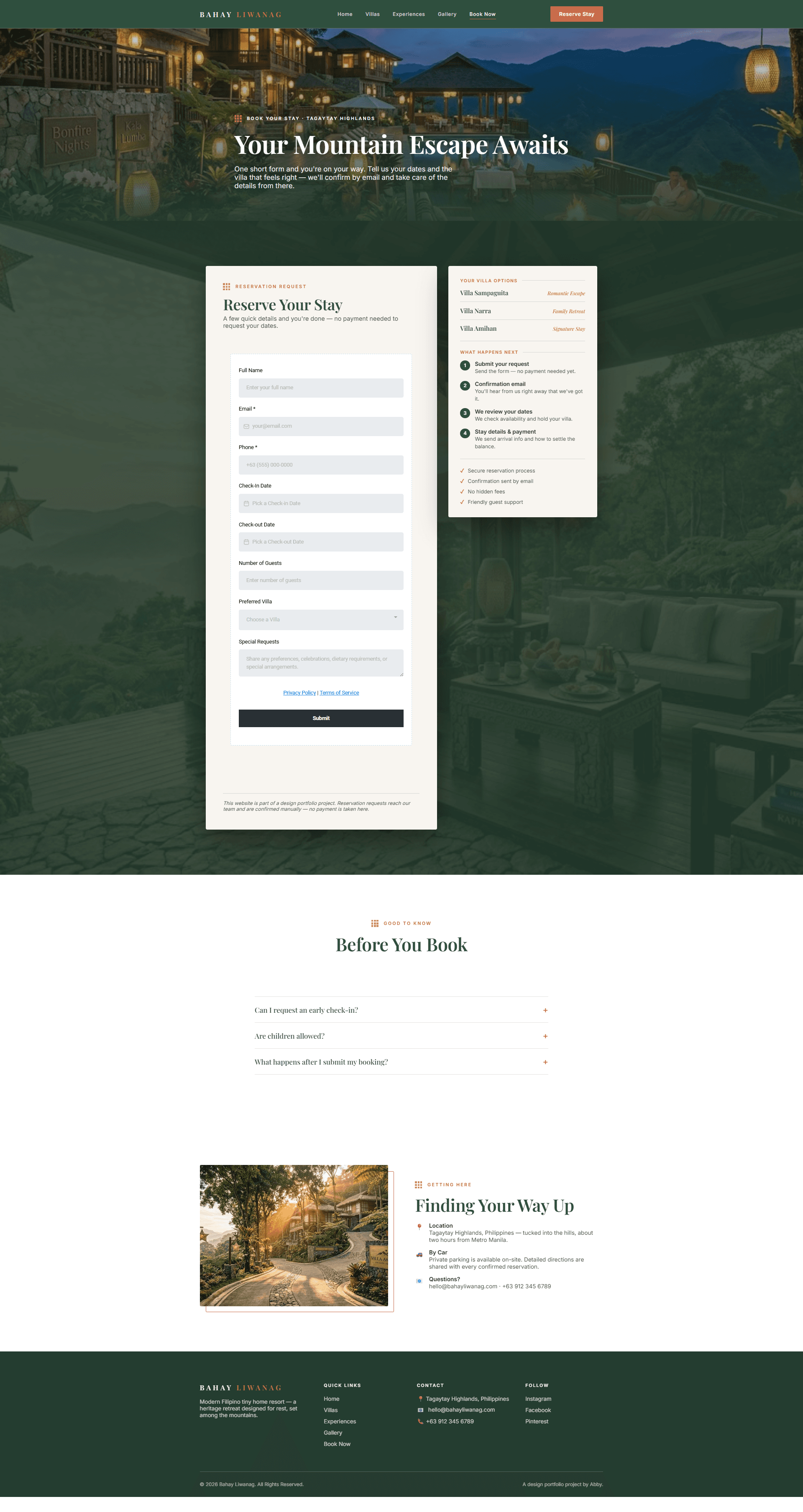
The clearest way to show what all of that looks like in practice is the booking system I built for Bahay Liwanag, a boutique resort — so here it is, in three plain steps.
What was slow
Bookings arrived as conversations — a form here, a message there. Every one meant copying the details somewhere, checking the dates, replying, and remembering to follow up.
What I built
One booking form that captures everything at once and files it on the guest's record. An automatic “we've got your request” to the guest. The details logged neatly to a reservations list, and a nudge to the team. The one thing left to a person, on purpose: checking the dates and saying yes.
What it took off their plate
The copying, the re-typing, the “did we ever reply?” — gone. What's left is the part that actually needs a human: the decision.
and in a different industry
Stephanie Center Wellness
A functional-medicine practice for women’s hair health. I rebuilt its education-first funnel inside GoHighLevel — and the sharpest decision was what not to touch: the email tool and the consultation software the practice already ran on stayed exactly where they were. Same spine as the resort — teach, capture once, and route to the human at the right moment — fitted to a very different business.
Read the full case studyProducts need systems, and systems need products
A good product still needs the quiet machinery behind it — and a good system deserves a product worth running. I build both. If any of this sounds like your problem, I’d love to hear about it.